Shift planning for 200 operators, when the rules can’t bend
Defining the UX strategy for an AI-powered shift and production planning tool. Pharmaceutical manufacturing, OEE optimization, and algorithmic scheduling under compliance constraints.
- Problem
- A pharma manufacturer had to move shift and production planning off spreadsheets and onto an algorithm, under OEE, union, and compliance constraints.
- Role
- UX strategy set with the Head of Design and the PM. I owned the interaction model and design principles. Two junior designers executed against that direction.
- Outcome
- A validated, fully interactive proof of concept that secured internal buy-in for algorithmic shift planning.

Role
UX Strategy & Direction
Timeline
2024
Company
Qampo
Client
Under NDA (Pharma)
A global pharmaceutical manufacturer was still planning shifts in spreadsheets, by hand. Production managers spent hours each week assembling plans, checking competency coverage, managing vacation conflicts, and reacting to daily disruptions, and every mistake had direct consequences for line efficiency and regulatory compliance. They needed a system that could handle the real complexity of modern production: OEE optimization (Overall Equipment Effectiveness), batch scheduling, union-agreement compliance, training requirements, and cross-team staffing that directly affects live output.
Qampo was brought in to build a proof of concept: could algorithmic planning work in this environment, and what should the interface for it look like?
The strategic decisions were made by three people: the Head of Design, the product manager, and me. Together we turned domain research into the product structure, the information architecture, the core interaction model, and the mental model that guided the entire design.
From there I owned the design principles and the day-to-day direction, making sure every decision held up against pharma-specific constraints: compliance traceability, high-risk decision visibility, and limited access to real end users. Two junior designers executed the screens against that direction, with review from the Head of Design, the PM, and me.
Every decision has cascading consequences
Moving one operator to cover an understaffed shift affects OEE on their original line. Scheduling training during a campaign period reduces throughput. Approving a vacation creates a competency gap that needs filling. Every action in the plan is connected, and the planner needs to see the ripple effects before committing.
We structured the product around four core surfaces.
Dashboard
The morning check
Plan
The weekly schedule
Scenarios
What-if planning
Teams
Competency mapping
Fig. 01 Dashboard
What needs attention this morning?
OEE forecast for the day, shift staffing across day/evening/night, active batch info, a 5-day and 3-month plan preview, and AI-generated suggestions for improving efficiency.
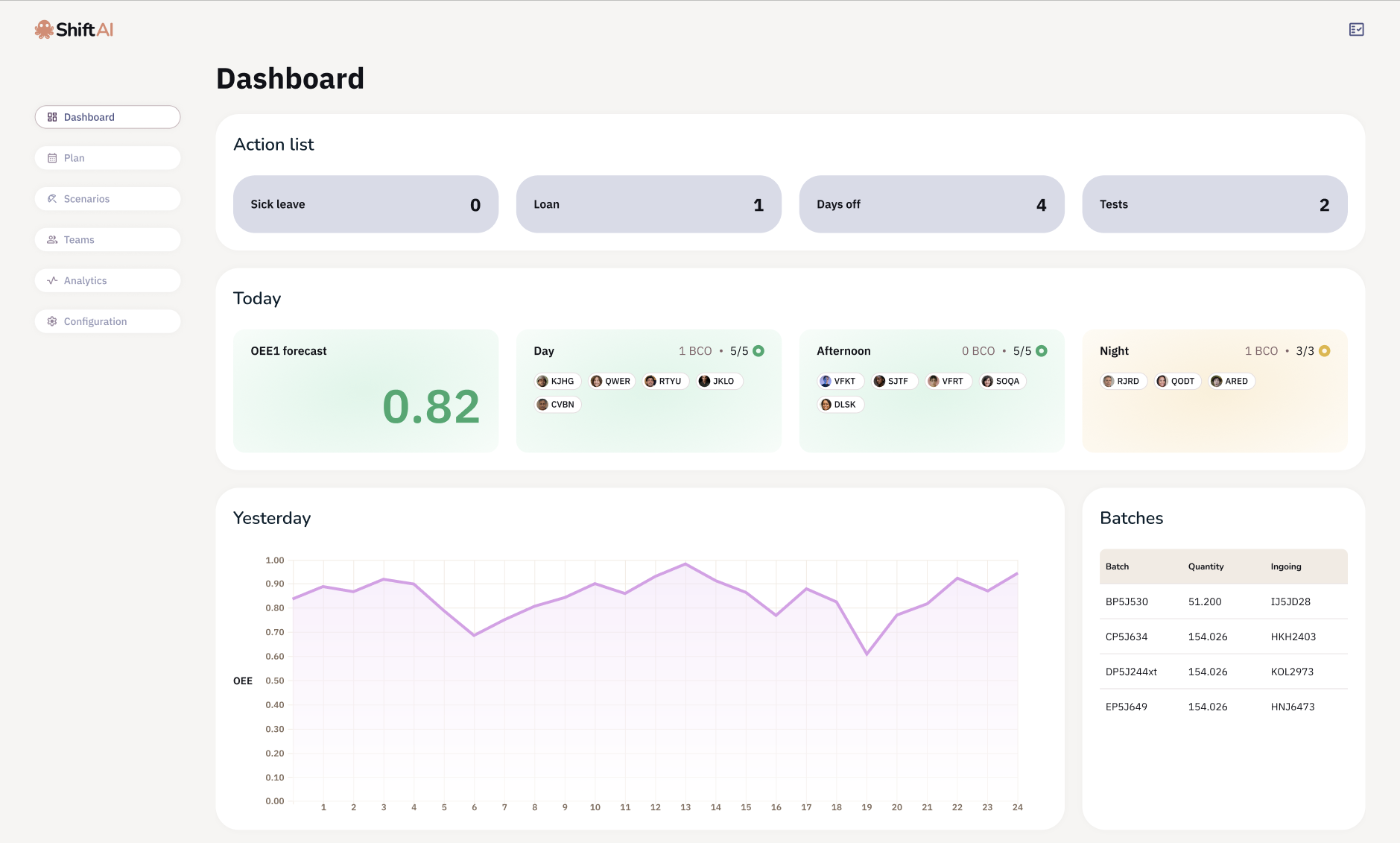
Actionable notifications over passive information. The notification panel groups by type: Actions (needing a decision), Leave (requests to approve), and Improve (algorithm suggestions). Loan requests expand inline to show the operator profile, origin and destination shifts, staffing impact, and response options. Understaffing alerts expand to show resolution options with the algorithm’s recommendation highlighted.
Fig. 02 Plan
The weekly production schedule
Two views: Team view (operators grouped by team, shifts across the week) and Shift view (all operators per shift type). Weekly KPIs at the top: OEE1 forecast, fairness score, and labor cost. Toggles for overlaying requests, fairness indicators, and price impact on individual cells.
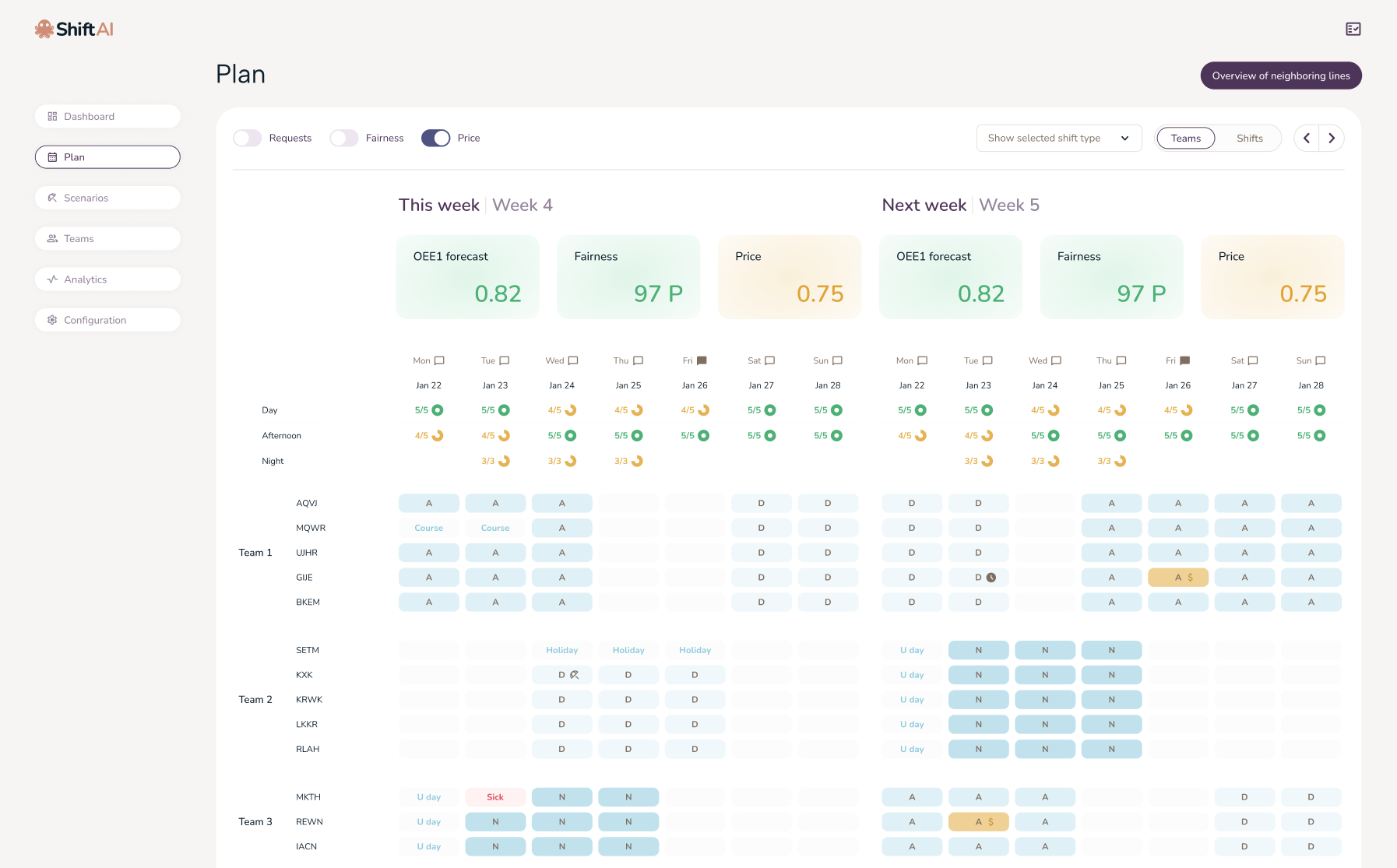
Fairness and price as planning lenses. “Fairness” and “Price” are toggleable layers on the same plan, not separate views. That mirrors how planners actually think: “this schedule works, but is it fair?” A detailed KPI breakdown shows fairness points (overtime, holiday work, shift moves, personal preference) and the price breakdown in DKK.
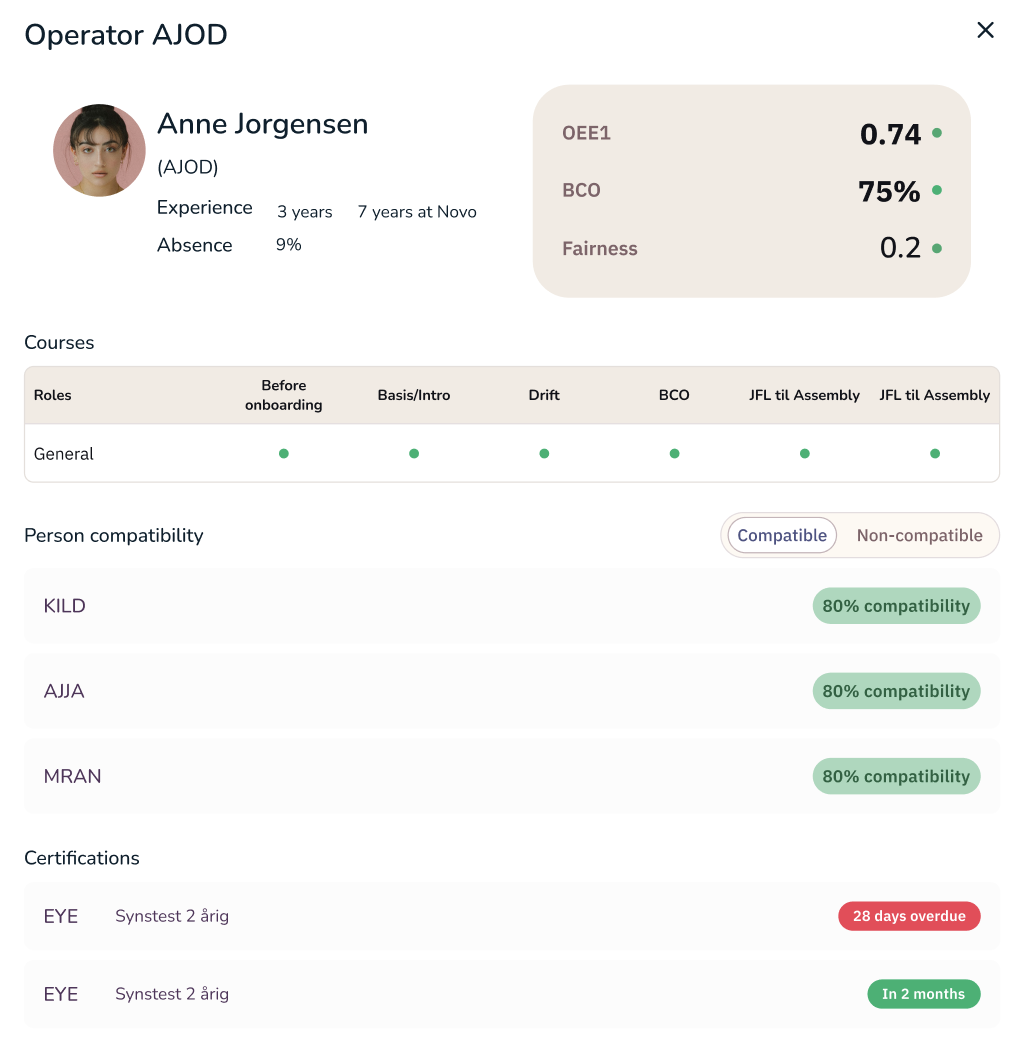
Competency-aware staffing. The loan-operator dialog shows more than availability: compatibility percentage, the origin shift and its staffing level, and the staffing impact at the destination. An operator at 80% compatibility with all six certifications is a better loan than one at 55% with three, and the system surfaces that so the planner can decide in seconds.
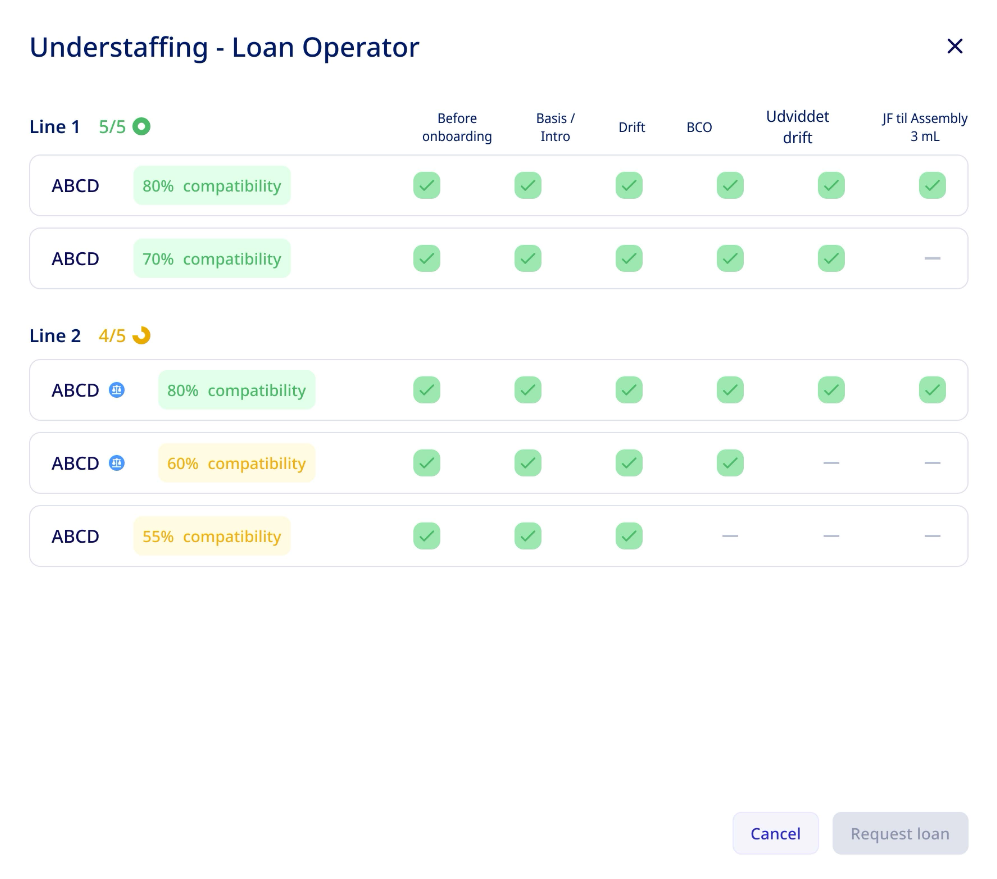
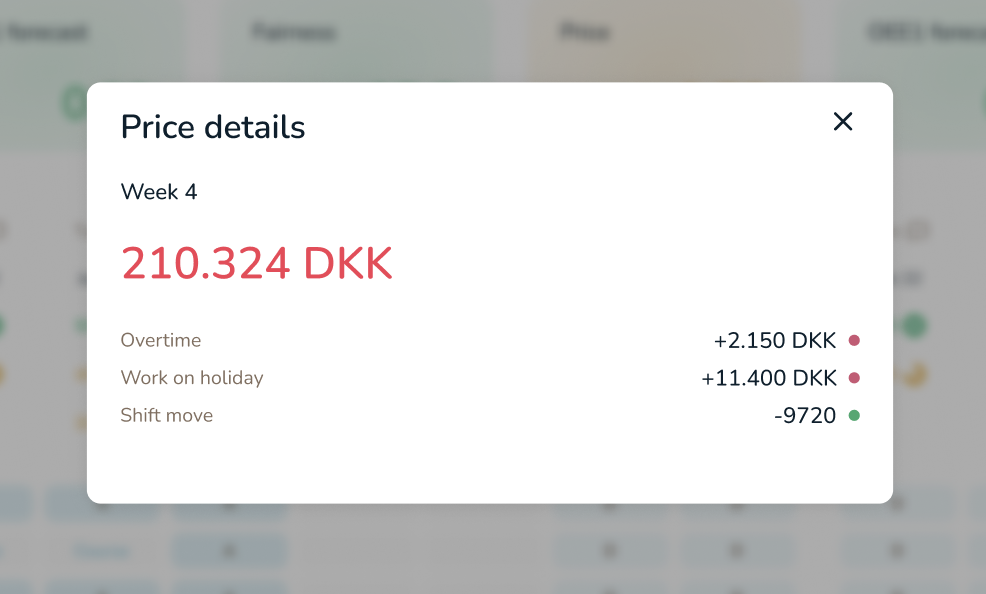
Fig. 03 Scenarios
What if we optimize for fairness instead?
Planners set the parameters (training periods, leave, campaigns, holidays), choose an optimization focus (OEE1, Fairness, Price, or Balanced), and the algorithm generates staffing alternatives. Each scenario produces its own plan preview, so they can compare before publishing.
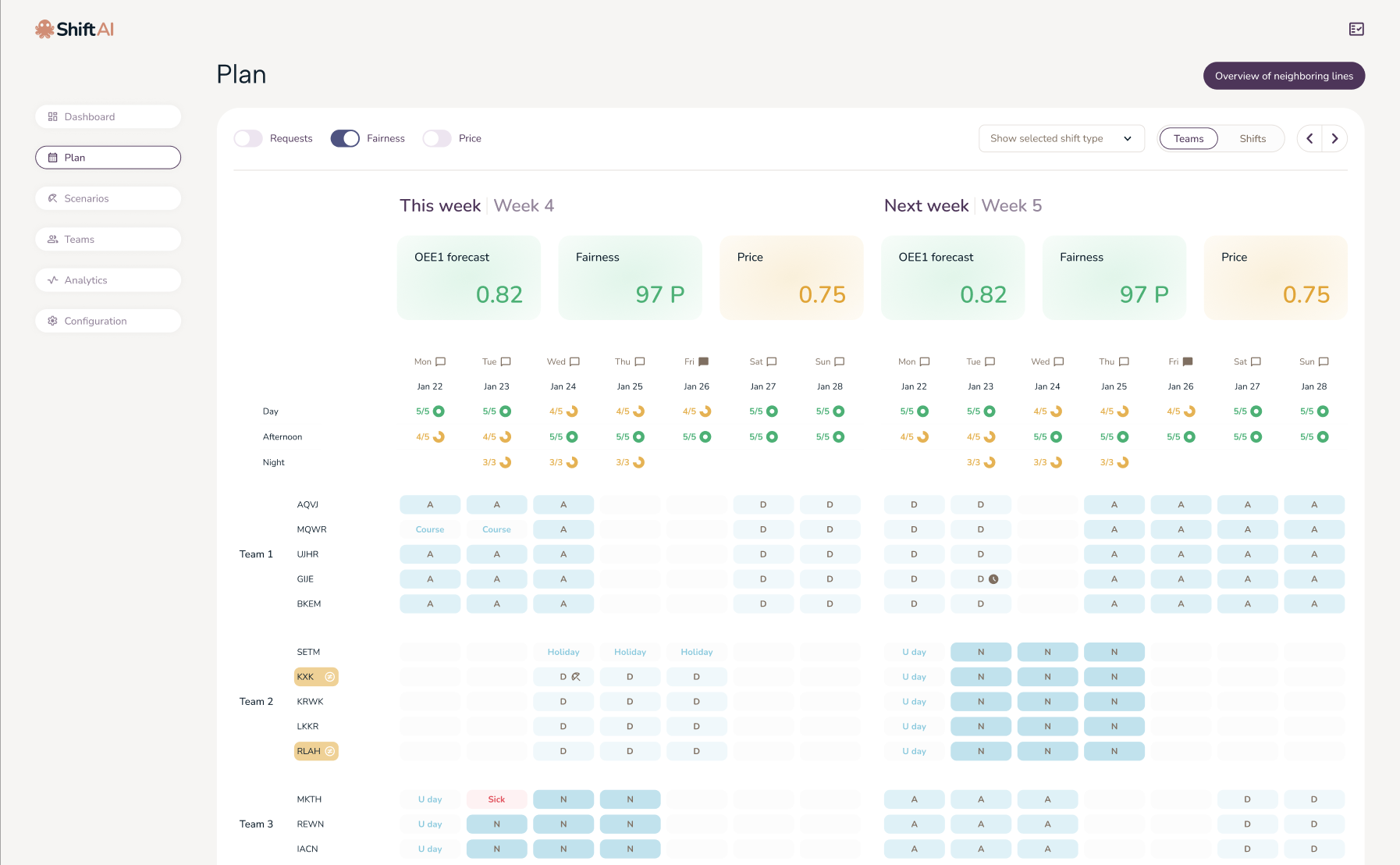
Fig. 04 Teams
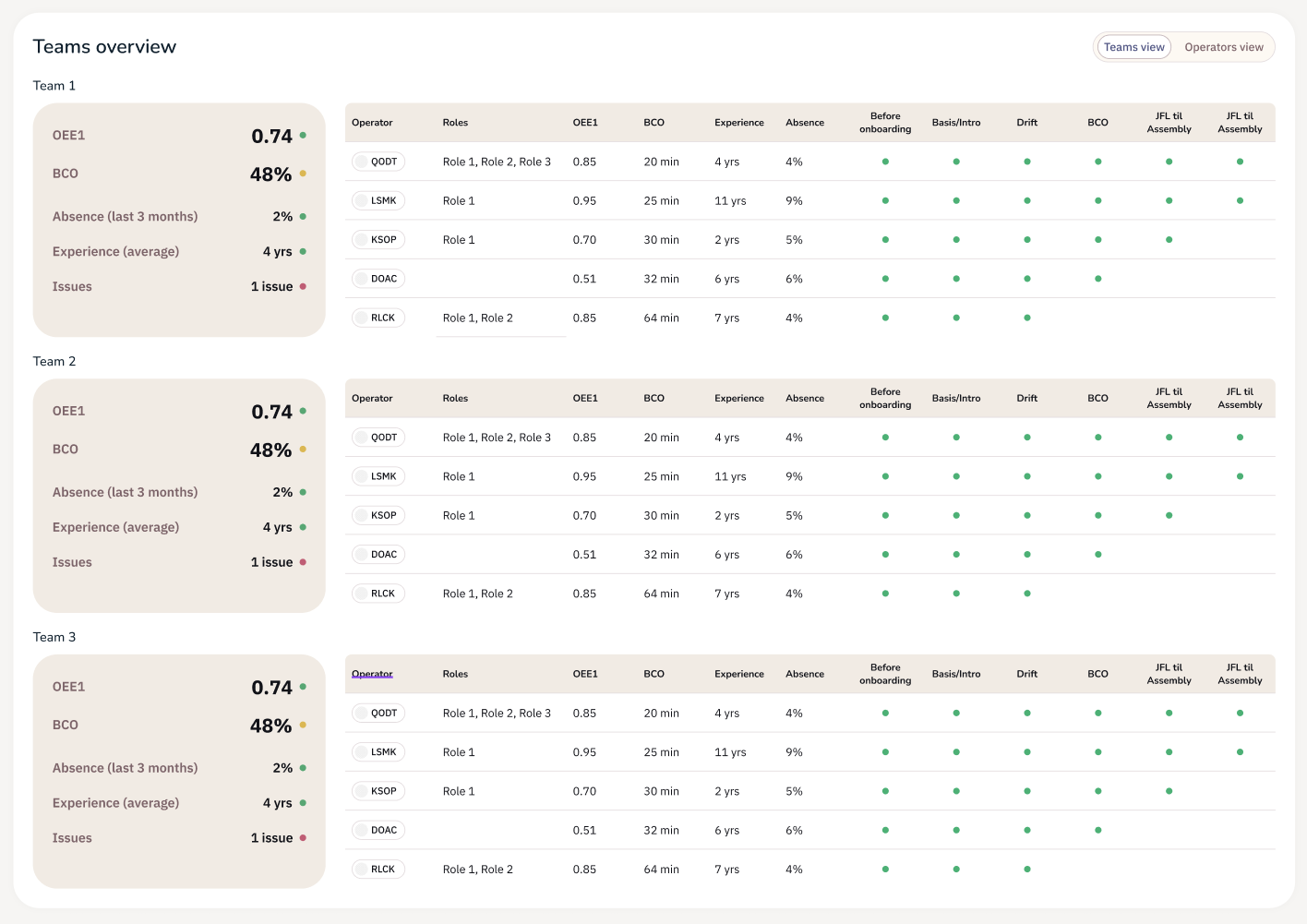
Who can do what, and where are the gaps?
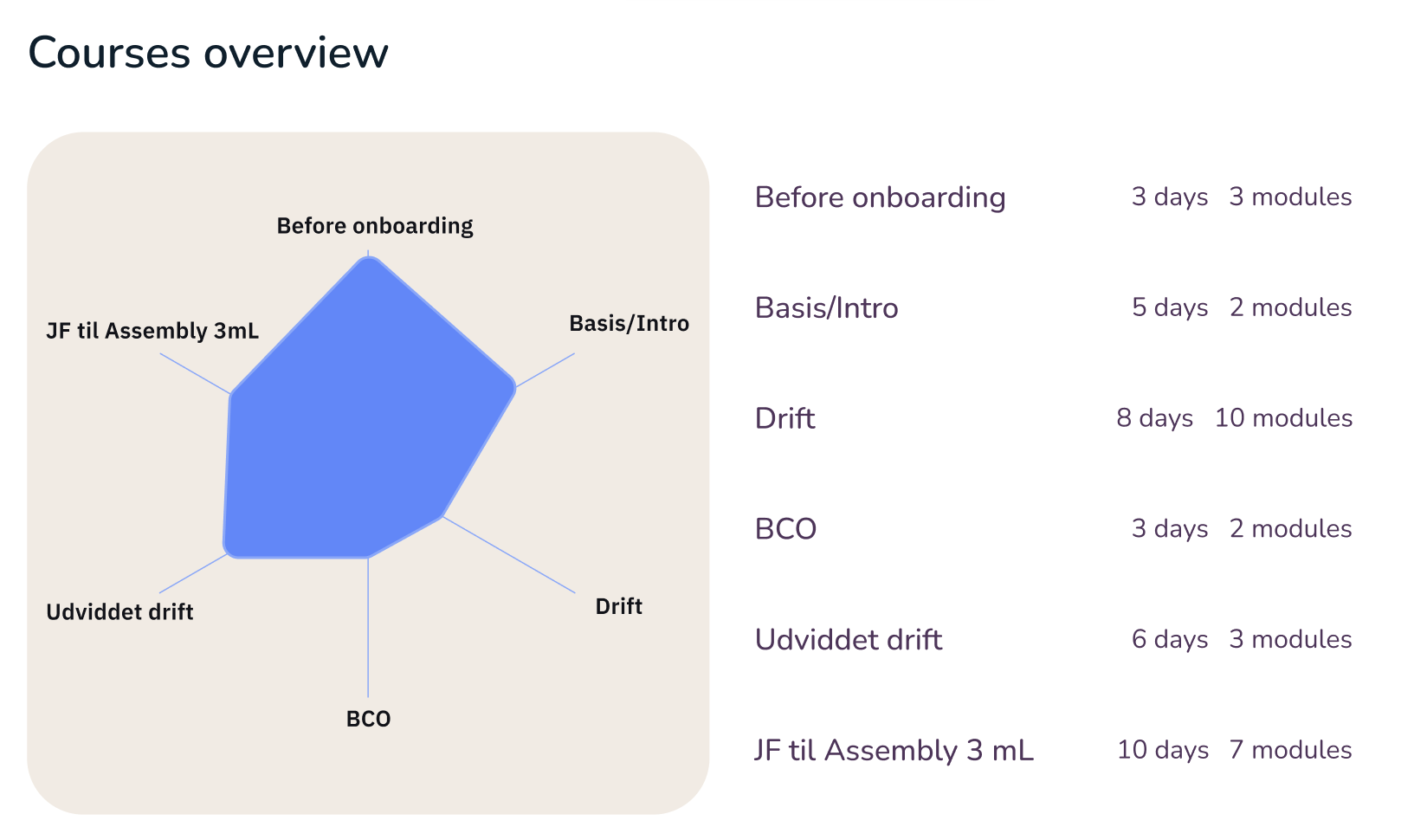
Competency mapping across six certification levels, from onboarding through advanced assembly qualifications. A spider diagram shows team-level training coverage at a glance. Individual operator profiles show OEE1 scores, BCO times, experience, compatibility scores, and overdue certifications.
Challenges
Pharma-specific complexity
The planning rules reflect real regulatory requirements: batch traceability, GMP compliance, equipment-specific certifications, and union agreements that vary by site. Every design pattern had to accommodate this without making the interface feel like a compliance form.
Limited direct user access
We had some access to actual production planners, but it was limited. Most domain knowledge came through internal experts. I wrote specific validation questions for every stakeholder session to test our assumptions.
High-risk decisions
A staffing mistake in pharma can affect batch quality, compliance records, and production timelines. Every interaction where the planner commits a change needed clear confirmation, a visible impact preview, and easy reversal.
Mixed team dynamics
With junior designers on execution and domain experts on strategy, we needed to balance usability with industrial specificity. The design language had to be consistent enough for reliable output while still encoding the domain constraints.
Outcome
The project delivered a fully interactive proof of concept: a clickable prototype covering the dashboard, production plan (Team and Shift views), scenario planning with algorithm-generated alternatives, team management with competency mapping, and the notification system. A demo video was produced and presented to the client.
The prototype validated the core premise: algorithmic shift planning works for pharmaceutical production when the interface gives planners control over the algorithm’s suggestions and clear visibility into the consequences of each decision. It’s been used to secure internal buy-in and as a reference for future planning work at the client’s production sites.
4
Core surfaces
PoC
Validated
Reflection
Direction matters more than pixel output
My contribution was defining the product structure, the interaction logic, and the design principles that guided the team. The junior designers delivered strong work because the foundation was clear. Knowing when to direct and when to step back is a skill that gets more important with seniority.
Pharma constraints are design constraints
Compliance, traceability, and union rules aren’t obstacles to good UX; they’re requirements that shape the interface just as much as user needs do. Treating them as first-class design inputs led to a better product than treating them as afterthoughts.
Proof of concepts prove more than feasibility
A good PoC doesn’t just show that something can be built; it shows how it should feel to use. The interactive prototype communicated the product vision more effectively than any spec document could have.